The last patient is the most expensive: why tackling health inequalities in primary care has a marginal cost problem

The NHS has made real progress on proactive care in recent decades. Investment in general practice, the expansion of disease registers, and structured call-recall systems have brought millions of patients into contact with preventive services that, a generation ago, they would never have received. That is worth acknowledging.
But uptake figures mask a structural problem that remains almost entirely unaddressed: the patients who do not respond to the standard recall processes are not distributed randomly across the population, they are concentrated in the most deprived communities, in the practices under greatest operational strain, and in the groups with the highest barriers to engagement. Reaching these patients costs substantially more than reaching anyone else.
This is the marginal cost problem in proactive primary care. It is not a clinical problem or a technological one, though technology has a role in the solution. It is fundamentally an economic and structural problem, and the NHS, at all levels, has not yet reckoned with it honestly.
The promise and the gap
Appt Health has recently done a lot of work with the NHS Cancer Programme on the uptake of cancer screening, so let's start with a case study there. Cervical screening is one of the most evidence-based preventive interventions in primary care: effective, cost-effective, and well-established. The infrastructure to deliver it, including infrastructure to manage patient registers, substantial grey and academic literature on the most effective invitations, and the care pathways, are all in place. And yet uptake remains stubbornly unequal.
For women aged 25 to 49, the gap in cervical screening coverage between the most and least deprived quintiles in England is 11 percentage points: 64.5% compared with 75.7%. That gap translates, according to Health Equity Evidence Centre analysis, into an estimated 520 cases of cervical cancer per year linked to deprivation. These are not statistical abstractions, they are preventable cancers in women who should have been screened.
The picture does not improve when you look at broader outcomes. The QOF programme, which began in 2004, succeeded in substantially reducing socioeconomic inequalities in primary care access and quality between 2004 and 2012. But healthcare outcome inequalities proved far more stubborn. By 2011/12, despite nearly a decade of investment and structural reform, socioeconomic inequality was still associated with 158,396 preventable hospitalisations and 37,983 deaths amenable to healthcare in England.
The NHS has largely solved the logistics of sending an invitation. What it has not solved is what happens when the invitation does not work.
The economics of the easy win
Think of patient engagement as a cost curve. The first cohort of patients, those who are motivated, digitally enabled, and able-bodied, respond to minimal intervention whether it is a letter, a self-booking link, a call from a GP receptionist. The cost per engaged patient is low, perhaps £3 to £5 all-in. This is where NHS performance metrics tend to plateau.
The trend data makes the point clearly. Across 59,271 GP practice-years, cervical screening coverage in England fell from 77% to under 72% between 2013/14 and 2021/22. That decline was not uniform: practices in more deprived areas fell furthest, despite comparable levels of workforce investment. The same finding emerges from NHS Health Check research: how a practice communicated its invitations mattered far less than which practice it was. The variation that explains low uptake is structural, not behavioural. It reflects resource, continuity, and capacity, and those things are not distributed equally.
Without being overly financial in a very human domain, the easy margin has been largely exhausted. What remains is harder, more expensive, and more unequally distributed.
The rising cost of the marginal patient
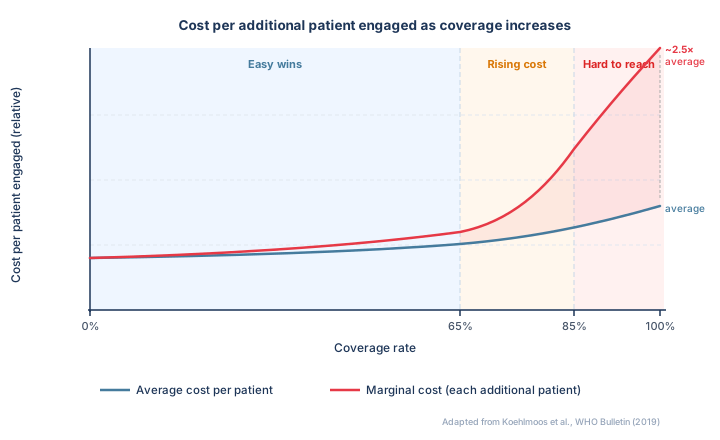
The concept of a rising marginal cost at the harder-to-reach end of any population health programme is well established in health economics. Modelling of universal health coverage shows that average and marginal cost track closely until around 50% coverage, begin to diverge at around 75%, and then rise steeply between 90% and full coverage. At universal coverage, the marginal cost of delivery is estimated at nearly 2.5 times the average cost across the programme. The mechanisms are intuitive: care needs become more complex, populations become harder to reach, barriers multiply, and workforce requirement increases.
The real-world cost data for cancer screening confirms this pattern. A systematic review of community outreach programmes found that the average cost to bring one additional hard-to-reach woman into breast screening was USD 545, and into cervical screening was USD 197, with substantial variation depending on the intensity of approach used. Whilst this is US data — and the US is a very different health system — the data is directionally indicative. Back in the NHS, a targeted cancer awareness intervention delivered in deprived communities in South Yorkshire and South-East Wales carried an implementation cost of £91.34 per participant, even for a relatively light-touch health literacy programme. And these are not the isolated costs of standard recall; they are the additional costs of reaching people for whom standard recall has already failed.
The barriers that drive these costs are multi-layered and compounding. For people with severe mental illness, NHS data shows they are around 20% more likely not to have participated in cervical screening within the recommended interval. For people with learning disabilities, NHS Digital statistics record cervical screening participation at 27.6% against 70% in the general population, a gap that persists across breast and bowel screening too. Standard recall pathways were not designed for these groups. They require different channels, more contacts, greater flexibility, and in many cases, active navigation or coordination support.
The same pattern holds when you look at care coordination experience more broadly. A 2025 Kings Fund survey found that 81% of people who described themselves as really struggling financially had experienced at least one problem with NHS admin and communications in the past year, against 63% of those who were financially comfortable. Among people with multiple long-term conditions, the figure was 77%, compared with 60% for those with no long-term conditions. These are not problems confined to the initial outreach stage. They accumulate across every point of contact with a patient, and they are concentrated in precisely the populations that are hardest to reach through standard recall processes.
Here is the point that a pure cost argument tends to miss: marginal patients are not only the most expensive to reach, they are also the patient group with most to gain. Harder-to-reach populations carry systematically higher disease burden, lower rates of early diagnosis, and worse outcomes from conditions that are entirely treatable when caught in time. The marginal benefit of engagement rises alongside the marginal cost. Put a different way, the NHS is not being asked to spend more to achieve the same outcome per patient, it is being asked to spend more to reach patients who stand to benefit most, and where investment is most likely to prevent downstream emergency admissions, avoidable hospitalisations, and premature death. The case for reaching the last 20% is stronger than a straightforward recall cost comparison would suggest.
The structural funding mismatch
The NHS funding model does not simply fail to compensate for this rising marginal cost. It actively compounds it. Practices serving the most deprived 20% of patients received £14 less per weighted patient in NHS payments in 2022 than those serving the least deprived quintile. By 2022/23, that disparity translated to 9.8% less funding per needs-adjusted patient across all income streams.
The workforce data underlines the consequences. Each additional full-time equivalent nurse per 1,000 registered patients is associated with a 1.94 percentage point increase in cervical screening rates. Workforce seems to be the most effective lever available. And it is concentrated in the practices least able to afford it.
The result is a structural inversion of need and resource. The practices facing the hardest marginal cost challenge are, by design, the worst placed to meet it.
What does it actually cost to engage one marginal patient?
There is no single published figure for the NHS primary care context, but the components are estimable from available data:
| Engagement touchpoint | Estimated unit cost | Notes |
|---|---|---|
| Automated letter | ~£1–2 | Print, postage, admin |
| SMS reminder | ~£0.05–0.10 | Bulk rate |
| Phone call (care coordinator) | ~£10–15 | Salary cost, ~10 min contact |
| Personalised outreach (longer call) | ~£25–40 | 30+ minutes, care coordinator time |
| Community health worker visit | ~£60–100 | Travel, time, preparation |
| Full patient navigation support | £100–200+ | Multiple contacts, cultural adaptation |
A patient who responds to an SMS with a booking link costs perhaps £3 to £5 all-in. A patient who requires more extensive support may cost 10 to 50 times more. The remaining unscreened population is disproportionately made up of the second group, but, with a focus on fixed targets and activity payments, the NHS currently funds most practices to hit 50% to 60%, yet expects them to somehow reach those marginal patients who will take them over 80%.
Why the standard model breaks at the margin
The standard NHS approach to proactive care relies on care coordinators manually working through lists and placing calls. It is efficient for motivated patients, and inefficient for everyone else. Without data-driven risk stratification, coordination time is distributed relatively evenly across the patient list rather than concentrated on those most likely to benefit. Each non-responsive patient requires a fresh cycle of record-checking, contact attempts, and follow-up for each failed encounter. The cost per successful engagement compounds quickly.
The consequences go beyond missed outreach. A 2025 Kings Fund survey found that 44% of people who had experienced poor NHS admin said it caused them to give up on seeking care or treatment altogether, and 41% said it made them less likely to seek care in future. Among patients from ethnic minority backgrounds, 77% had experienced at least one NHS admin issue in the past 12 months, compared with 65% of people from white ethnic backgrounds. The standard model does not just fail to engage harder-to-reach patients proactively. It actively erodes their confidence in the system over time.
Patient navigation programmes specifically designed for disadvantaged populations have demonstrated value precisely because they provide personalised support in overcoming layered and intersecting barriers. But this comes with a staffing and cost model that most GP practices cannot sustain at scale, and the NHS has not funded them to do so.
Bending the curve

The marginal cost problem in proactive primary care is not unsolvable. But solving it requires rethinking how coordination effort is allocated, not simply increasing its overall volume.
Three levers matter here. First, automation of the standard pathway: if reliable digital outreach handles the first 45% to 55% of patients, care coordinator time is freed for the patients who genuinely require human contact. The same workforce can cover more ground. Second, better targeting: risk or need-based patient stratification means coordination effort is directed toward those most likely to be disengaged and most likely to benefit, rather than spread uniformly, or prioritised based on arbitrary factors like a patient's birth month. Appt Health's Recall service demonstrated an 18 percentage point increase in screening uptake, with a 60% patient response rate to automated invitations, whilst income-related inequalities in uptake were eliminated. Third, adaptive rather than fixed pathways: rather than a standardised recall sequence of SMS, reminder, letter, workflows that escalate intensity based on non-response signals reduce unnecessary contacts while concentrating resource on genuine non-responders.
None of this replaces community health workers, cultural liaisons, or flexible appointment models. It amplifies them, by ensuring that human capacity is deployed where it is most needed.
A funding and policy challenge, not just a product one
Technology can bend the cost curve. But it cannot fix the structural mismatch between need and resource that the NHS has allowed to persist for years.
The practices serving the most deprived communities are, in effect, cross-subsidising the NHS's health inequality commitments with their own depleted capacity. Commissioners, Integrated Care Boards, and NHS England need to acknowledge plainly that reaching the last 20 to 30% of patients costs structurally more, and fund accordingly. Average-cost economics do not apply uniformly to every patient on the list.
The marginal patient is the hardest to reach and the most expensive to engage. They are also the patient with the most to gain. The NHS built its founding principles on that logic. It is time to fund proactive care as if it still believes it.

- Health Equity Evidence Centre (2024). What works: Addressing inequalities in the uptake of cervical screening. heec.co.uk
- Asaria M, Ali S, Doran T, et al. (2016). How a universal health system reduces inequalities: lessons from England. Journal of Epidemiology and Community Health, 70(7):637-643. pmc.ncbi.nlm.nih.gov
- Hirani S, Calderwood C, Hunt K, et al. (2024). Factors associated with cervical screening coverage: a longitudinal analysis of English general practices from 2013 to 2022. Journal of Public Health, 46(1):e43. academic.oup.com
- Koehlmoos T, Gazi R, Hossain S, Rashid M (2019). Costing universal health coverage. Bulletin of the World Health Organization. pmc.ncbi.nlm.nih.gov
- Rao A, Bhattacharyya P, Pinkney T, et al. (2024). Evaluation of the cost-effectiveness of evidence-based interventions to increase female breast and cervical cancer screens: a systematic review. Cancers, 16(6):1134. mdpi.com
- Whitaker K, Scott S, Peacock R, et al. (2021). Randomised controlled trial and economic evaluation of a targeted cancer awareness intervention for adults living in deprived areas of the UK. British Journal of Cancer, 125:1469-1481. pmc.ncbi.nlm.nih.gov
- NHS Digital (2022). Health and care of people with learning disabilities, experimental statistics 2021 to 2022: cancer screening. digital.nhs.uk
- NHS England / UKHSA (2023). Severe mental illness: inequalities in cancer screening uptake. gov.uk
- Health Equity Evidence Centre (2024). Structural inequalities in primary care: the facts and figures. heec.co.uk
- Jabbal J, Maguire D, Sherlaw-Johnson C, et al. (2025). Still lost in the system? The urgent need for better NHS admin. The King's Fund. kingsfund.org.uk